
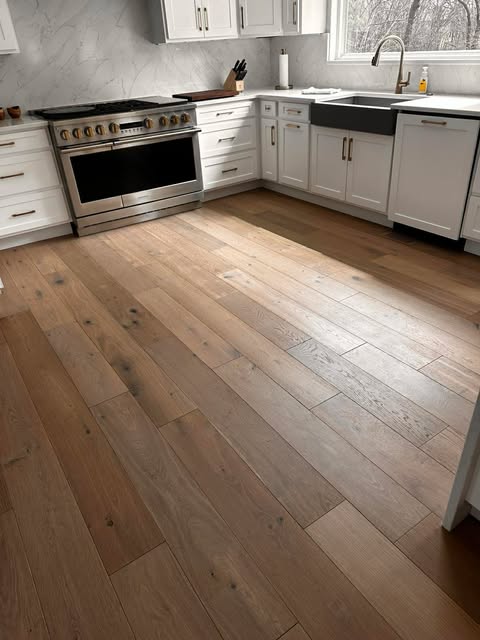
Short answer: small gaps between hardwood boards that open up in winter are usually normal. Wood shrinks a little when the air gets dry, and in St. Louis the air inside a heated home gets very dry from December through February. Keeping indoor humidity between 30% and 50% keeps most winter gaps small and helps them close again by summer.
Are gaps in hardwood floors in winter normal?
In most cases, yes. Wood is hygroscopic: it constantly takes up and gives off moisture to match the air around it. As indoor air dries out in winter, each board loses a little moisture and shrinks across its width, so thin gaps appear between boards. When the air gets more humid in spring and summer, the boards take moisture back and the gaps close.
The National Wood Flooring Association (NWFA) recommends indoor conditions of roughly 30% to 50% relative humidity at normal living temperatures. An NWFA inspector explains that small seasonal swings of about 1% to 2% in the wood's moisture content are normal and cause the small gaps that open in winter and close in summer.1
Why St. Louis winters make hardwood gaps worse
Cold air holds very little moisture. When that air leaks into your home and your furnace warms it to 70°F, its relative humidity drops sharply, even though the air outside feels damp. We looked at five years of hourly weather data (2021 to 2025) for our High Ridge, Missouri location to see how big that effect is.2
| Month | Average outdoor temperature | Average outdoor humidity | Share of hours below freezing | Same air heated to 70°F (no moisture added) |
|---|---|---|---|---|
| November | 47°F | 67% | 11% | about 30% |
| December | 40°F | 72% | 25% | about 24% |
| January | 31°F | 71% | 49% | about 17% |
| February | 36°F | 66% | 39% | about 19% |
| March | 48°F | 65% | 7% | about 30% |
How to read this: the last column is a calculation, not a reading from inside a home. It shows what the relative humidity would be if outdoor air at that month's average temperature and humidity were simply warmed to 70°F with nothing added to it. Cooking, showers, plants and the people in the house add moisture, so real indoor humidity is usually higher. But the trend is the point: in a typical January, nearly half of all hours in High Ridge are below freezing, and the air your furnace is heating holds very little moisture to begin with.
Looking at every hour from December through February, about 79% of the hours would leave heated outdoor air under 30% relative humidity if nothing were added. That is below the 30% to 50% range that NWFA recommends, and it is why so many St. Louis homeowners notice gaps in hardwood floors from December through February.
Gaps, cupping and cracking: what each one means
People often search for three different problems, and they have different causes:
- Gaps between boards. Usually dry air. Common in winter, and often closes in summer.
- Cupping. The edges of each board rise higher than the center. It is a sign that the wood has taken on more moisture than it can release, often from a humid summer (outdoor humidity in High Ridge averages 74% to 76% in July and August), a leak, a damp basement or crawl space, or a spill that sat for too long. Cupping needs the moisture source found and fixed.
- Cracking or splitting. Can come from very dry air, but also from damage, a worn finish, or an installation problem. A crack in a single board is different from many boards gapping evenly across a room.
What humidity should hardwood floors have?
Keep indoor relative humidity between 30% and 50%.1 A hygrometer is the easy way to know where you stand. These are inexpensive, and one placed in the room with the most hardwood tells you more than the weather forecast. If the reading drops below 30% in winter, the floors will tend to open gaps. If it stays above 50% in summer, you risk cupping.
8 ways to protect your hardwood floors this winter
- Measure first. Place a hygrometer near the floor in a main living area and check it daily during the first cold snap.
- Add moisture gently. A whole-house humidifier on your furnace, or portable humidifiers in the rooms with the most hardwood, can bring a very dry house back toward the 30% to 50% range.
- Do not overdo it. Pushing humidity above 50% to "stop" gaps can cause cupping and window condensation. Aim for the range, not the top of it.
- Keep the thermostat steady. Steady indoor temperatures make humidity easier to hold inside the 30% to 50% range.
- Do not aim heat at the floor. Keep space heaters off hardwood and avoid placing furniture over floor vents, so no area of the floor gets much hotter and drier than the rest.
- Use felt pads and mats. Dry wood scratches more easily. Pad furniture and put mats at the door to catch grit and winter salt.
- Clean with as little water as you can. Wet mopping adds moisture to the wood and can leave finish damage. Use a manufacturer-approved hardwood cleaner on a barely damp cloth.
- Do not fill the gaps. Fillers and caulk can crack or squeeze out when the boards swell again in summer. We generally advise waiting until the humid season to see how much of the gap closes on its own.
When gaps are not normal
Call a flooring professional if you see any of these:
- Gaps that are still wide after a humid summer.
- Gaps that are uneven across a room, or only in one area.
- Boards that are cupped, crowned, buckled or lifting.
- A new floor that gaps in its first winter. Installation, acclimation or humidity during installation may be the cause.
- Gaps next to a kitchen, bathroom, exterior door or basement stairs, which can point to a moisture source.
Our team serves High Ridge and the surrounding St. Louis area, including Ballwin, Fenton, Wildwood and Eureka. If a floor is worn, scratched or dull, hardwood refinishing can restore it after the humidity problem is under control.
Solid or engineered: which gaps less?
Solid hardwood moves with the seasons, and some movement is part of owning it. Engineered hardwood has a layered construction that is more dimensionally stable, which is why we often recommend it for homes on concrete slabs, finished basements and houses that back onto wooded lots where humidity swings more. You can read more about the options on our engineered hardwood and hardwood flooring pages.
Frequently asked questions
Why are there gaps in my hardwood floors in winter?
Dry indoor air pulls moisture out of the boards, so each one shrinks slightly across its width. In a heated St. Louis home in December through February, the air is often far below the 30% to 50% humidity range that NWFA recommends.
Will the gaps close on their own?
Small seasonal gaps usually close as humidity rises in spring and summer. Gaps that stay open after a full humid season, or that are wide and uneven, should be inspected.
What is the best humidity level for hardwood floors?
NWFA recommends roughly 30% to 50% relative humidity at normal living temperatures.1 Use a hygrometer to check, and adjust with a humidifier in winter or a dehumidifier or air conditioning in humid months.
Should I fill the gaps in my hardwood floor?
We generally advise against filling gaps in winter. The wood expands again in humid weather, and rigid filler can stress the boards. Ask a flooring professional before you fill anything.
Does a humidifier fix hardwood floor gaps?
It can stop gaps from getting worse and let them close faster, but it will not close a gap overnight. Raise humidity gradually and keep it inside the 30% to 50% range.
Is engineered hardwood less likely to gap?
Engineered hardwood is generally more stable than solid hardwood because of its layered construction, so it usually moves less. It is still wood, so keeping humidity in the recommended range matters for both.
Get your floors checked before the coldest weeks
If your hardwood floors are gapping, cupping or cracking, request a free estimate or call Kelly's Flooring at (636) 677-5555. We are a family-owned flooring store at 2311 Little Antire Rd in High Ridge, Missouri, serving the St. Louis area since 1978, and we can look at the floor, find the cause and tell you honestly whether it needs repair, refinishing or just better humidity.
Sources and method
- National Wood Floor Consultants, "Hardwood Floor Moisture Content: What Is Normal," citing NWFA recommended indoor conditions of about 30% to 50% relative humidity and normal seasonal gap behavior. nationalwoodfloorconsultants.com
- Hourly temperature and relative humidity for High Ridge, MO (38.48°N, 90.56°W), 2021 to 2025, from the Open-Meteo Historical Weather API. The "heated to 70°F" column is our own calculation using the Magnus saturation vapor pressure approximation, assuming no moisture is added to the air. open-meteo.com
Ready to Get Started?
Contact Kelly's Flooring for a no-obligation estimate on your flooring project.