
Engineered Hardwood Flooring in St. Louis, MO
The warmth and authenticity of real hardwood with the dimensional stability that Missouri's humidity demands. Wide-plank white oak, hickory, maple, and more — installed by Kelly's Flooring since 1978.
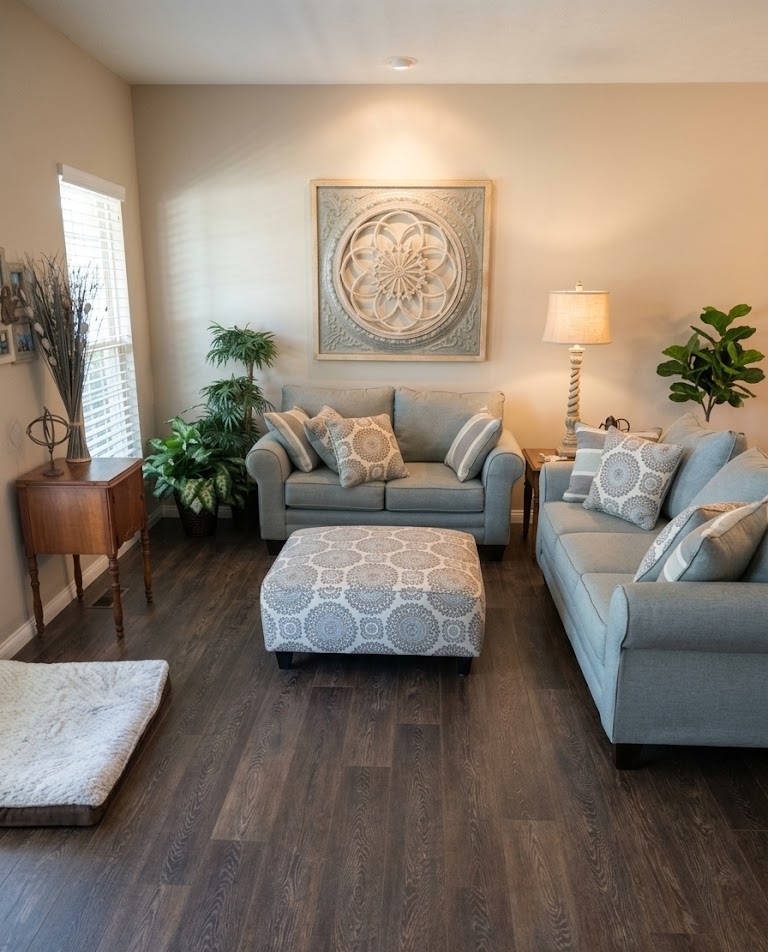
Engineered Hardwood Flooring — St. Louis’s Smart Wood Choice
Engineered hardwood is built from a real-wood veneer bonded over a cross-ply plywood or HDF core. The real wood surface gives you the authentic look, feel, and warmth of solid hardwood — the same species, the same grain, the same refinishable surface. The engineered core is what makes it smarter for Missouri: it resists the seasonal expansion and contraction that solid hardwood experiences as humidity swings between a dry winter and a humid August.
At Kelly’s Flooring, we carry engineered hardwood in white oak, red oak, hickory, maple, walnut, and other species — in widths from 3¼ inches up to 9 inches, and in finishes from natural clear to deep espresso to modern gray. Our High Ridge showroom has hundreds of samples, and our installation crews know exactly how to prepare Missouri concrete and wood subfloors for a long-lasting result.
- In-home measurement and estimate throughout Greater St. Louis
- Wide-plank options up to 9 inches — the most popular width right now
- White oak, hickory, maple, walnut, red oak, and more
- Matte, satin, wire-brushed, and hand-scraped finish options
- Nail-down, glue-down, and floating installation methods
- Can be refinished 1–3 times depending on veneer thickness
- Old flooring removal and subfloor preparation included
Why Engineered Hardwood Is Right for Most St. Louis Homes
Missouri’s climate is genuinely hard on solid hardwood. Engineered construction solves the problem without sacrificing the beauty of real wood.
Missouri humidity is the issue. Solid hardwood expands in summer humidity and contracts in winter dry heat — up to ½ inch of movement across a 12-foot-wide room. That movement causes gaps, cupping, and buckling, especially in homes near the Meramec River corridor or with limited climate control. Engineered hardwood’s cross-ply core reduces this movement by up to 80%, giving you stable floors year-round without seasonal surprises.
Below-grade and on-concrete installations. Solid hardwood cannot be glued or floated over concrete — moisture vapor from concrete slabs destroys the wood from below. Engineered hardwood can be glued directly to concrete (with proper moisture testing and vapor barrier) or floated over it. This makes it viable for finished basements, main-floor additions over slab, and any room where solid hardwood simply doesn’t work.
Thickness and refinishability. Engineered hardwood veneers range from 2mm to 6mm depending on the product line. Thicker veneer layers (4mm and above) can be sanded and refinished once or twice, extending the floor’s life considerably. For most homeowners in the Greater St. Louis area, this is more than adequate — and at 45 years of installation experience, we’ll recommend the right veneer thickness for your project goals.
When solid hardwood is still the right choice. For above-grade installations in older homes with well-controlled humidity (basements with full dehumidification, homes with whole-house humidifiers), solid hardwood remains a beautiful and long-lived option. We carry and install solid hardwood as well, and we’ll give you an honest recommendation based on your actual home conditions — not just what’s most convenient for us.
Engineered Hardwood Species We Carry
Every species has a distinct grain character, hardness, and look. Here’s how the most popular ones compare for St. Louis homes.
White Oak
The top-requested species in St. Louis right now. Straighter grain than red oak, warmer undertones, and a neutral appearance that works with virtually any cabinet or wall color. Takes stain extremely well — from natural blond to deep ebony. Available in 5” to 9” wide planks with wire-brushed and matte finishes.
Hickory
The hardest domestic hardwood species, making it ideal for households with dogs, high foot traffic, or active families. Dramatic color variation from cream to deep brown within a single plank gives each floor a distinctive character. Popular in farmhouse, rustic, and transitional interiors.
Maple
Fine, consistent grain with a light, creamy appearance. Maple’s uniform look works well in contemporary and mid-century modern interiors. It’s very hard (slightly harder than white oak), making it durable in active households. Best in natural or very light stain tones — it doesn’t absorb dark stains as evenly as oak.
Walnut
Rich chocolate brown tones with a flowing, open grain that photographs beautifully. American black walnut is softer than oak or hickory, so it shows marks more easily — but its distinctive color means it’s chosen by homeowners who specifically want that deep, warm look. Particularly popular in Chesterfield and Kirkwood home renovations.
Red Oak
The classic American hardwood that built the flooring industry. Red oak’s open grain has a pink-to-amber undertone and accepts stain beautifully. It’s the most common species in St. Louis homes built before the 1990s. Engineered red oak is ideal when you’re extending existing solid red oak flooring and need the new section to blend with refinished originals.
Wide Plank (6”+)
Species is one decision; plank width is another. Wide-plank engineered hardwood at 6 to 9 inches creates a more open, contemporary feel with fewer seam lines across the floor. It’s proportionally better suited to the larger open plans in newer St. Louis homes and the renovated spaces in older homes where rooms have been opened up. Wide plank is our most-requested specification in 2025.
Engineered Hardwood Installation Throughout Greater St. Louis
We serve all of St. Louis County, Jefferson County, and the surrounding metro area from our High Ridge showroom.
St. Louis
Engineered hardwood throughout St. Louis City and County — compatible with the 1920s–1960s homes common throughout the area.
St. Louis hardwood →Chesterfield
Premium wide-plank white oak and walnut for Chesterfield’s executive homes and Clarkson Valley estates.
Chesterfield hardwood →Wildwood
Engineered hardwood for Wildwood’s large-footprint homes — wide-plank options that suit open floor plans.
Wildwood hardwood →Kirkwood
Matching and extending original hardwood in Kirkwood’s historic bungalows and mid-century homes.
Kirkwood hardwood →Ballwin
Engineered hardwood for Ballwin’s 1980s–1990s slab-foundation homes where solid hardwood can’t be used.
Ballwin hardwood →Fenton & Arnold
Engineered hardwood throughout Jefferson County and south St. Louis County — with fast scheduling from our High Ridge showroom.
Fenton & Arnold hardwood →Engineered Hardwood FAQ
Ready to See Engineered Hardwood in Your Home?
Schedule a in-home consultation. We’ll bring samples from our top engineered hardwood lines, measure your space, and give you a detailed written estimate.