
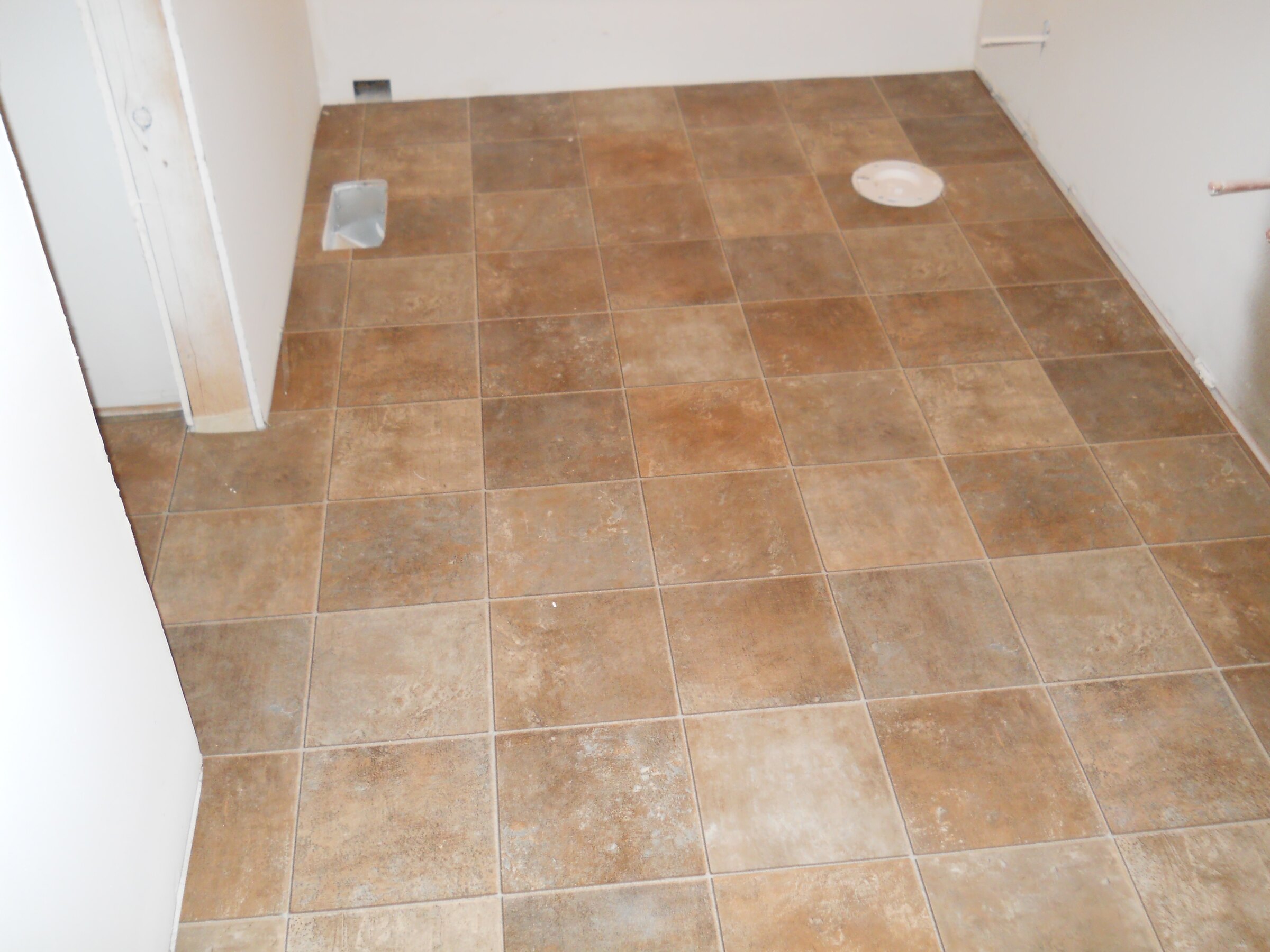
Short answer: linoleum flooring is a natural resilient floor made mostly from linseed oil, wood flour, rosin, limestone and a jute backing. It is durable, long-lasting and comfortable underfoot, but it costs more than vinyl, it is water-resistant rather than waterproof, and it is not the same product as vinyl. For most St. Louis kitchens, laundry rooms and basements we steer homeowners toward sheet vinyl or luxury vinyl plank, and we keep linoleum for people who specifically want a natural floor.
What is linoleum flooring?
Linoleum is one of the oldest resilient floors. The Englishman Frederick Walton is credited with discovering it in 1855, when a jar of linseed oil left open formed a flexible skin. The name comes from the Latin words for flax (linum) and oil (oleum).1
Modern linoleum still follows that idea. Forbo, the maker of Marmoleum, lists its ingredients as flax seed oil, wood flour, pine rosin, jute, limestone and pigments.2 Because the color runs through the full thickness of the sheet, the pattern does not sit on a printed top layer the way it does on most vinyl.
Linoleum vs. vinyl: the real differences
People often use the two words as if they mean the same thing. They do not. Linoleum is made from natural ingredients, while vinyl is a synthetic floor made from polyvinyl chloride (PVC).3 That one difference drives most of the points below.
| Linoleum | Vinyl (sheet, tile or plank) | |
|---|---|---|
| Made from | Linseed oil, wood flour, rosin, limestone, pigments, jute backing | PVC, a petrochemical resin |
| Water | Water-resistant, can be damaged by heavy or repeated exposure | Waterproof |
| Looks | Fewer colors and patterns, color runs through the sheet | Huge range, including wood, stone and tile looks |
| Typical lifespan | 20 to 40 years | 10 to 20 years |
| Sealing | Older-style floors need re-sealing every 3 to 10 years | Never needs sealing |
| Cleaners | Gentle or linoleum-specific products | Tolerates most cleaners |
| Heat | Better heat resistance | Can melt under high heat |
The lifespan, sealing, heat and water comparisons in this table come from Bob Vila's linoleum-vs-vinyl guide.3 Real life depends on traffic, subfloor, installation and how the floor is cleaned.
Pros of linoleum flooring
- Long lifespan. Bob Vila puts linoleum at 20 to 40 years against 10 to 20 for vinyl.3 Forbo says its Marmoleum can last over 40 years with the recommended cleaning and care.2
- Natural ingredients. If avoiding PVC matters to you, linoleum is the main resilient alternative.
- Color through the sheet. There is no thin printed layer to wear through.
- Heat tolerance. It handles heat better than vinyl does.3
- Easy day-to-day care. It can be swept, vacuumed and mopped like other resilient floors, using a gentle cleaner.3
Cons of linoleum flooring
- Higher cost. See the cost section below.
- Not waterproof. It resists water but can be damaged by significant exposure.3 That matters in basements, bathrooms and any room with a leak risk.
- Limited designs. You can choose from far fewer patterns than vinyl offers, and nothing that imitates wood or stone as convincingly.
- Cleaner limits. Harsh cleaners are out. Forbo recommends a pH-neutral all-purpose cleaner.2
- Sealing on some floors. Bob Vila says linoleum needs sealing every 3 to 10 years depending on traffic.3 Forbo says its Marmoleum has a factory-applied finish and needs no wax sealer, so ask about the exact product you are considering.2
- Needs a smooth subfloor. Sheet flooring of this type shows bumps and uneven spots, so the subfloor must be flat and sound before installation.3
How much does linoleum flooring cost?
Prices vary by product, room size and how much prep your subfloor needs. These published ranges give you a starting point:
- Sheet linoleum: about $5 to $7 per square foot (Bob Vila, 2022).3
- Linoleum tiles: about $3 to $5 per square foot (Bob Vila, 2022).3
- Sheet vinyl: about $0.50 to $2 per square foot, and vinyl tile around $3.50 (Bob Vila, 2022).3
- Installed linoleum, national average: HomeWyse estimated $4.72 to $6.40 per square foot in May 2026, assuming a level, smooth subfloor. Removing old flooring, debris disposal and any repairs can add to that.4
The 2022 figures are older than the 2026 estimate, so treat them as a guide to how the products compare, not as a quote. For a St. Louis price on a specific room, see our flooring installation cost guide or ask for a free estimate.
Where linoleum works well, and where we would pick something else
- Kitchens: a good fit if you like the natural look and will wipe up spills promptly. If you have a dishwasher or ice maker that could leak, a fully waterproof floor gives more peace of mind. See our kitchen flooring options.
- Mudrooms and entryways: durable, but snow melt and road salt make a waterproof floor attractive in a Missouri winter.
- Laundry rooms: leaks from a washer are the main risk, so we usually suggest sheet vinyl or LVP here.
- Bathrooms and basements: we recommend waterproof flooring instead. Read more about bathroom flooring, basement flooring and waterproof flooring.
Do you already have old linoleum in your home?
Many older Missouri homes still have original sheet flooring under newer layers. Bob Vila notes that older linoleum could contain asbestos, which was no longer used after the 1970s.3 HomeWyse also lists asbestos handling as an extra cost on removal jobs.4 If your floor is old and you plan to remove it, have it tested before anyone sands, scrapes or tears it up.
Cold November floors and heating season
As the weather cools, a lot of homeowners start thinking about cold floors. If your home has in-floor heating, check that the specific floor you choose is approved for it before you buy. Forbo, for example, points to a separate standard and factsheet for installing Marmoleum over underfloor heating.2 Whatever resilient floor you choose, follow the manufacturer's instructions on room temperature and acclimation during installation.
Frequently asked questions
Is linoleum flooring the same as vinyl?
No. Linoleum is made from natural ingredients such as linseed oil and wood flour. Vinyl is a synthetic PVC product.3
Is linoleum flooring waterproof?
No. Linoleum is water-resistant and handles spills, but it can be damaged by significant water exposure.3 Vinyl is the better choice for wet areas.
How long does linoleum flooring last?
Estimates range from 20 to 40 years with good care,3 and Forbo says Marmoleum can last over 40 years when cleaned and maintained as recommended.2 Actual life depends on traffic, moisture and installation.
Is linoleum cheaper than vinyl?
Usually not. Sheet linoleum runs about $5 to $7 per square foot against roughly $0.50 to $2 for sheet vinyl.3 Linoleum's longer lifespan can narrow the gap over time.
Does linoleum flooring need to be sealed?
It depends on the product. Bob Vila says it needs sealing every 3 to 10 years,3 while Forbo says its Marmoleum has a factory finish and needs no wax sealer.2 Follow the instructions for the floor you buy.
Can I put linoleum in a kitchen?
Yes, if you wipe up spills promptly. If a leak is a real possibility, a waterproof floor is safer.
What cleaner should I use on linoleum?
Use a gentle, pH-neutral cleaner made for the floor. Forbo recommends a pH-neutral all-purpose cleaner and protective feet on chairs and tables.2
Not sure whether linoleum is right for your room?
Tell us where the floor is going and we will give you an honest recommendation, whether that turns out to be linoleum, sheet vinyl or luxury vinyl plank. Request a free estimate or call Kelly's Flooring at (636) 677-5555. We are a family-owned flooring store at 2311 Little Antire Rd in High Ridge, Missouri, serving the St. Louis area since 1978.
Sources and method
- Katherine Martinko, "A Fresh Look at Linoleum," Green Building Advisor (May 16, 2024). The history and name origin come from the visible introduction of this article. The rest of the article is behind a paywall and was not used. greenbuildingadvisor.com
- Forbo Flooring, Marmoleum FAQ (Australia site). Used for the ingredient list, the factory finish and cleaning guidance, the life-expectancy statement and the mention of underfloor heating. This is a manufacturer's own statement about its product. forbo.com
- Savannah Sher, "Linoleum vs. Vinyl Flooring: What's the Difference?", Bob Vila (July 29, 2022). Used for the material, water, sealing, heat, lifespan and price comparisons. Prices are from 2022. bobvila.com
- HomeWyse, "Cost to Install Linoleum Flooring" (May 2026 estimate). A national average, not a St. Louis quote. homewyse.com
- Room recommendations reflect Kelly's Flooring's installation experience in the St. Louis area and are general guidance. Always follow the manufacturer's installation instructions and warranty terms for the specific product you choose.
Ready to Get Started?
Contact Kelly's Flooring for a no-obligation estimate on your flooring project.